

A strategic guide to website redesign, website refresh, and brand-aligned digital growth
There is a quiet moment in almost every growing business when something starts to feel slightly out of sync.
Nothing is broken.
Your website is not “bad.”
But it no longer feels like a full reflection of who you are now.
Your experience has deepened. Your positioning has sharpened. Your clients may be more refined. Your offers are clearer. Your pricing has likely evolved. You are operating at a different level than you were even a year or two ago.
And yet your website is still telling the older version of the story.
That is usually when we get the call.
At The Mina Company, we work with established, service-based businesses that are growing into their next phase. Most of the time, the issue is not visibility alone. It is alignment. When your website no longer matches your brand authority, your growth goals, or your audience, it quietly creates friction.
A strategic website is not a digital brochure.
It is positioning.
It is infrastructure.
It is a conversion strategy.
When it evolves with your business, momentum follows.
What Does “Updating a Website” Actually Mean?
Many business owners ask:
- Do I need a brand-new website?
- Can I just refresh what I have?
- Is this a design issue or a strategy issue?
- How do I know if my website is hurting conversions?
The answer depends on your growth stage and goals.
Website evolution typically falls into three categories:
- Full website build (from the ground up)
- Strategic website refresh or refinement
- Brand and website realignment for scaling
Here is what each looks like in practice.
1. Building a New Website From the Ground Up
Best for: Businesses that have outgrown their original positioning, audience, or structure.
When a company evolves significantly, incremental updates are not enough. The foundation itself must shift.
Case Example: Jo Leda Counseling
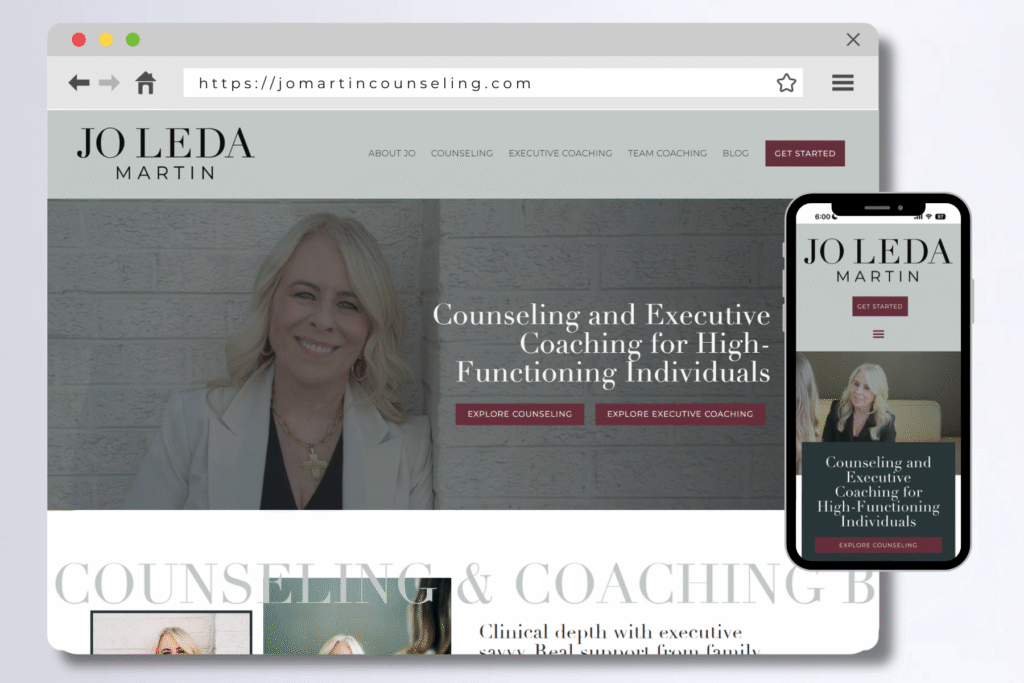
For Jo Leda Counseling, the objective was elevation. The work she was doing with high-capacity leaders had expanded. Her authority had deepened. The website needed to reflect that level of clarity and confidence.
Strategic Focus Areas:
- Refined positioning for executive leaders and decision-makers
- Elevated brand visuals aligned with professional authority
- Clear messaging that bridges personal and professional growth
- Conversion pathways that feel direct but not pushy
Why a Full Rebuild Was Necessary
A website rebuild is recommended when:
- Your ideal client has changed significantly
- Your pricing or service model has evolved
- Your brand identity has matured
- Your current structure limits SEO performance
- Your design undermines perceived authority
Outcome:
A website that supports higher-level clients, clearer authority positioning, and long-term organic visibility.
2. Refining and Refreshing an Existing Website
Best for: Businesses with a strong foundation that needs optimization, clarity, and cohesion.
Not every business needs a full redesign. Sometimes the structure is solid, but messaging and design require refinement.
Case Example: Arnica Mental Health
Arnica Mental Health already had a functional website. The core structure worked. However, the messaging did not fully reflect specialization areas like ADHD and trauma-informed therapy.
Strategic Refinement Focus:
- Clarifying specialty keywords (ADHD therapy, trauma therapy, adult mental health)
- Strengthening on-page SEO and content hierarchy
- Simplifying user navigation
- Improving visual cohesion and readability
When a Website Refresh Is the Right Move
A website refresh is often ideal if:
- Your messaging feels vague
- Your homepage does not clearly communicate your niche
- Your SEO is underperforming
- Visitors are not converting into inquiries
- Your design feels inconsistent but not fundamentally flawed
Outcome:
Stronger search visibility, clearer specialization authority, and smoother user flow.
3. Aligning Website + Brand for Scalable Growth
Best for: Businesses preparing for expansion, partnerships, speaking, or new offers.
When your brand evolves, your website must support not only credibility but scalability.
Case Example: The Financial Edit
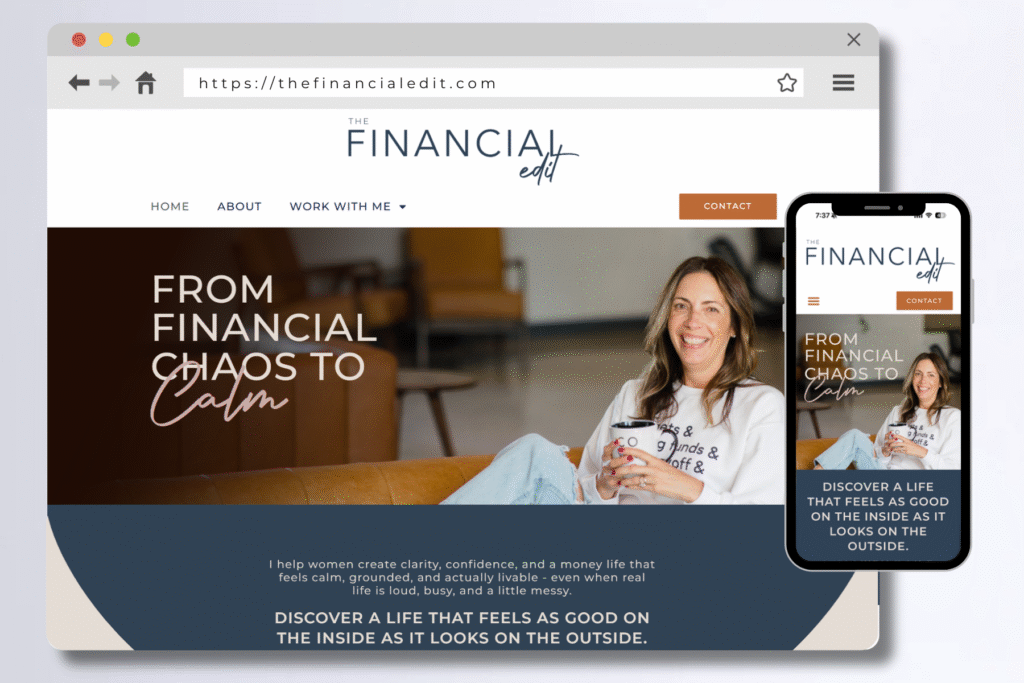
The Financial Edit had matured into a more authoritative financial education brand. The website needed to communicate both accessibility and expertise.
Strategic Alignment Focus:
- Clarifying service and offer hierarchy
- Strengthening messaging authority without losing warmth
- Enhancing SEO structure for long-term content growth
- Creating a cohesive visual identity aligned with trust
Why Alignment Matters for Growth
When preparing to scale, your website should:
- Support thought leadership
- Convert higher-value clients
- Reflect brand maturity
- Align visually and strategically across all platforms
- Work seamlessly with email, ads, and content marketing
Outcome:
A website positioned as a growth asset rather than a static online presence.
How to Know If It’s Time to Redesign or Refresh Your Website
You may need a website redesign or strategic refresh if:
- You hesitate to send people to your website.
- Your brand visuals have evolved but your website has not.
- Your offers have changed or expanded.
- Your pricing has increased.
- Your inquiry rate has plateaued.
- You are attracting the wrong type of client.
- Your messaging no longer feels accurate.
A high-performing website should:
- Clearly communicate who you serve
- Establish authority quickly
- Guide visitors through a natural conversion path
- Support SEO visibility
- Reflect your current brand level
If it does not, alignment work may be necessary.
Strategy First. Design Second.
One of the biggest misconceptions about website redesign is that it is primarily about aesthetics.
Design matters. But strategy matters more.
At The Mina Company, website projects begin with:
- Audience clarity
- Offer refinement
- Brand voice alignment
- SEO structure planning
- Conversion pathway mapping
Because a visually beautiful website without strategic positioning does not convert.
A strategically built website becomes:
- A client acquisition system
- A credibility anchor
- A scalable marketing asset
- A long-term visibility engine
What Results Can a Strategic Website Deliver?
When aligned properly, a website can:
- Increase qualified inquiries
- Improve search engine rankings
- Attract higher-level clients
- Shorten sales cycles
- Strengthen perceived authority
- Support long-term content marketing
Website alignment is not a cosmetic update. It is operational infrastructure for growth.
Frequently Asked Questions
1. How do I know if I need a full website redesign or just a refresh?
If your audience, pricing, or positioning has changed significantly, a full redesign may be necessary. If your structure is solid but your messaging or design feels outdated, a strategic refresh may be sufficient. A professional audit can clarify which approach supports your growth goals.
2. How often should a business update its website?
Most growing businesses should revisit their website strategy every 18–36 months. This does not always mean a redesign, but it should include SEO updates, messaging refinement, and conversion optimization to stay aligned with market shifts.
3. Does redesigning a website help with SEO?
Yes—when done strategically. A redesign that includes keyword optimization, content restructuring, internal linking, and technical improvements can significantly improve organic visibility. However, aesthetic changes alone will not impact search performance.
A Website Should Reflect Where You’re Going
Your website should not just reflect where you have been.
It should support where you are headed.
If your business has evolved, your digital presence should evolve with it.
Whether that means a full rebuild, a thoughtful refinement, or a strategic realignment, alignment is often the missing piece between growth and sustainable momentum.
When strategy, structure, and brand clarity work together, your website becomes more than a platform.
It becomes infrastructure.